
Mummy Dearest, Part II
Wrap around the World

“In Sicily, death has always been part of life. And for centuries many Sicilians were using mummification to make sure there was a constant relationship between life and death.”
— Paleoanthropologist Dario Piombino-Mascali
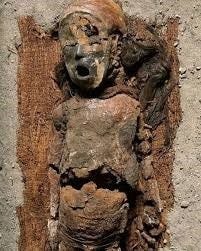
THE OLDEST DELIBERATE MUMMIES were discovered not in Egypt but on a fertile strip of land between the Pacific Ocean and a desert in what is now coastal Chile and Peru. They belong to the Chinchorros, fishermen and women dating from 7,000 BCE to 1,500 BCE.
The mummification process varied over the culture’s 5,500 years. The simplest (and latest) method involved drying out the body and then covering it with a thick mud that was then molded and painted to look like the deceased. Another (earlier) technique involved removing the head, limbs, organs and skin and then using clay, reeds and other materials to rebuild the body. Sticks might be used to reinforce the skeleton, and the skull was reattached to the neck. In many cases, according to Ralph and Wright’s Secrets of the Dead, “the skin was rolled back over the limbs and torso, the head covered by a wig of human hair, and the body painted with black or red pigment.”
Every Chinchorro was mummified – rich and poor, infants, children and adults. These mummies often hung out with the families for years; relatives might drop by to visit with the mummies.
On the other side of the world, in Palermo, Italy, friars at the Catacombe dei Cappuccini started mummifying their fellow monks at the onset of the 17th century. After a while, the friars offered their embalming and display services to the civilian population. Those on display were first dried out on a pottery table for about a year. The bodies were then washed with vinegar, stuffed with straw and bay leaves, and then dressed up in whatever was the current fashion. The catacombs contain 1,252 mummies. The last to be mummified was the Count of Isnello in 1939.
The Scythians galloped across the plains of the Siberian steppe between 900 and 200 BCE. They were warriors, nomads, traders. They mummified their dead by
removing the brain through holes drilled into the skull,
pulling out flesh, muscles and organs through cuts made in the skin,
packing the body with straw and hair,
adding their prized possessions to the coffin (sometimes including horses and chariots), and
burying the whole kit-and-caboodle in a “cabin” in a pit.
A 15th-century mummified cat was discovered inside the walls of a church in the Netherlands. The cat is believed to have been sealed there to protect the building from evil spirits.
In Japan, followers of the legendary Kūkai, who died in 835, practiced Sokushinbutsu, a weird kind of self-mummification. Kūkai was a monk, scholar, engineer, poet and artist who founded a major school of Buddhism. The buzz is that Kūkai cut back on eating and drinking and allowed himself to die of starvation. He ate only nuts, roots, tree bark and pine needles. With death close at hand, his body lacked fat, muscle and moisture. He dried up and became a living skeleton. Until 1903, many monks imitated Kūkai’s regimen of self-mummification but only twenty succeeded.
It makes you wonder, doesn’t it?, why people around the world who never communicated, who never even knew about each other’s existence, developed many of the same beliefs and funerary practices.
Next week: A good death
Perfect post for mummy’s day.